Friday, April 10, 2020

Investments


June 2030

Nadia was tired of waiting to take control of her future, but had very little savings. But she wanted a baby so much that she felt it in her bones. What she wasn’t feeling was any meaningful connection with the guys she met on the five swipe-dating applications on her phone. She had read the statistics. Every year she waited, she risked infertility. Why should she wait for a man to have a baby?

On the other hand, Nadia still really wanted to find Mr. Right, even Mr. Right enough. She knew statistically her odds of finding love as a single mom would drop drastically. If she were divorced with kids, it wouldn’t be that big of a deal. But for single moms finding a good, decent human being to love is just not easy.

In addition, she had her career to think about. Women can have it all? That’s been proven to be false. It would be very difficult for her to teach full time at the suburban school where she had recently been tenured with a child.

So she would go to Mexico. In Mexico, the fertility treatments were safe and literally 10 times cheaper. She applied for a Fertility Loan from the bank (since the clamp down on immigration and the decline of the American birth rate, the loans were interest free), and once she had her approval, she set up the meetings with her department chair and principal.

She requested a leave of absence to spend the school year in Mexico to improve her Spanish. Her administrators lauded her decision, as they had recently been fined by the Federal Government for not serving their Spanish speaking population.

“We can put Nadia’s efforts into the report, “ Dr. Martin said excitedly, speaking as if Nadia wasn’t there. He had his PhD or Ed.D, but no one knew exactly in what. They just knew they had to call him Dr.

“Thank you for the approval, Dr. Martin,” she said.

In June, after the last day of school, Nadia found someone to sublet her apartment. She moved in with her parents and after the first day of her menstrual cycle, she flew direct from Chicago to San Diego. She didn't tell her parents what she was doing. Only that the school had given her time to learn Spanish. She crossed the border over to Tijuana which would be her home away from home for the next few months. After checking in at the hotel, she spoke to the Director of International Admissions to confirm her arrival.The next day she would leave her hotel and check into the Tijuana International Fertility Clinic. It was the only clinic in Mexico where the entire fertility process was in-patient. She did not understand the rationale, however, she was happy to be in a secure place. She also didn’t relish taking all of the shots as her hands shook when she was nervous. The staff there would do it for her.

The Fertility Clinic looked more like a spa than a clinic. She imagined this must be similar to the drug rehab facility her college roommate frequented. There were drink stands with herbal teas, water with cucumber, and fruit drinks. After filling her water bottle, she headed to the lab to have her blood drawn and vaginal ultrasound taken. While she waited for the results, she unpacked in her room. It was the size of an efficiency apartment, but that’s all she really needed. Besides, this was temporary. The wifi connection was strong. What else did she really need?

The nurse phoned to say her test results looked good and that she should return to the lab for her first set of shots to stimulate ovulation. Nadia ovulated regularly, but she knew that they wanted to harvest as many eggs as possible to ensure success. For 12 days a month, for three months, Nadia awoke, took a blood test, received a vaginal ultrasound, waited for the phone call from the nurse, went back to the lab and received shots. In the time between, she read, watched Netflix, and selected a sperm donor. Twenty five percent of her eggs she would inseminate and fifty percent she would leave in case she did actually meet Mr. Right. The other 25 percent would probably not be high enough quality.  After each harvest, Nadia felt bloated, but was in good spirits. During her first harvest, the doctor said that he saw at least 10 eggs on the ultrasound. When the anesthesiologist asked her to count down from 10 as he inserted the IV into her arm, she made one last joke: 10 eggs, 9 eggs, 8 eggs, but by 8 she was out.

Nadia finished the process with 60 eggs. It was almost certain that she would become a mother one day. During her last round of IVF, she picked a sperm donor for some of the eggs. In the end, after looking at the quality of the eggs, they would turn five of the eggs into embryos and freeze them, in case she never met someone with whom to share her life.

Nadia left the clinic with 57 frozen eggs and 3 level one frozen embryos - two didn't fertilize for whatever reason. Nadia was thrilled. She signed the paperwork, hugged her favorite phlebotomist Maria goodbye, and headed to the airport for an intensive Spanish seminar in Mexico City.


June, 2045

Nadia met her husband of two months Christopher at a wine bar in Lincoln Park.

“Damnit, I can’t believe this place isn’t handicapped accessible,” Nadia said to Christopher, lamenting her bad choice.

Christopher was in a wheelchair. He had been paralyzed after being hit by an IED during his tour of duty in Iran. On their third date, Christopher told Nadia that he couldn’t have children. On the fifth date, Nadia told Christopher about the clinic in Tijuana. She had spent the last decade or so liberated by the fact that she could have children on her time table, not on anyone else’s. She didn’t treat each date as a man whom she could possibly marry. She could be relaxed and just enjoy her life.

They left the wine bar and headed over to the Mexican restaurant with burritos and frozen margaritas as big as your head.

“It’s a bit dumb to be eating Mexican food the day before we go to Tijuana,” Christopher said.

“The food there isn’t like this. This is American-Mexican food,” Nadia said.

Christopher nodded and sipped his drink. The tequila was making him sleepy.

The next day Christopher and Nadia boarded the plane. They each had two suitcases. Each one cost $100 to bring on the plane, but they would need everything that they packed.

After tipping the Uber driver generously, he helped them to unload their luggage at the Airbnb. On their way to the Fertility Clinic, they held hands, unable to contain their excitement. They had made this appointment ten months ago, the day after their engagement, and couldn’t wait to get started. Then they headed to the fertility clinic. Maria was there to welcome her. She had been promoted to Director of the International Department, and they hugged like long lost friends.

“You must be Christopher,” Maria said.

“The one and only,” Christopher smiled.

“Both of you can put on your hospital gowns and then come with me,” Maria said.

“Why do I have to wear a hospital gown?” Christopher asked, looking uncomfortable.

“We must maintain a sterile environment, Mr. Christopher,” she said.

A tech disinfected Christopher’s wheelchair, and they suited up and went through three steel doors that required fingerprints, retina scans, even a DNA sample. Finally, it was time.

The dark room mimicked the sounds of a womb. It was loud but calming. Maria walked them over to the sealed tank filled with thick fluid.

“Meet Baby Xlh9z56 and Baby Ynotg7h44,” Maria said with a tear in her eye. She had done this many times, but she had always felt a special connection with Nadia.

“Would you like to do the honors, Dad?” asked Maria. “The password is today’s date. Don’t forget the 20 for the year.”

“Ha! That’s the passcode for our Airbnb,” laughed Christopher.

They all chuckled. Then Christopher pressed the code for the first tank and then the second. Within five seconds, the fluids from both tanks came gushing out into the drainage system. Two nurses were ready with towels and scales. They were perfect. She weighed 6 pounds, four ounces; he weighed 7 pounds, two ounces. Beautiful eyes. Beautiful screams. They whisked the babies to the postnatal rooms. Both Nadia and Christopher took off their shirts to hold the babies skin to skin.

“They’re perfect,” Nadia cried as she gave her baby girl her first bottle.

“Yes,” Maria said. “They all are.”

Thursday, April 9, 2020

Scared to Die in the Wilderness

So last night in  my vanity, I decided to post on social media pictures of my family and Passover Seder table. Before doing so, I Googled the Exodus story, one I've read many times before, to find a quote to put on the social media post.

[If you're surprised that I'm talking about the Bible, skip to the bottom]

I should know this by now. Anytime I look in the Hebrew Bible, I'm struck at how messed up the story is and how mean God is. So I posted the pictures without a quote. But something from what I read yesterday really struck me and stayed with me this morning. 

Following the 10th plague, after the Israelites fled Pharaoh with his permission, he then changes his mind. 

And the Egyptians pursued after them, all the horses and chariots of Pharaoh, and his horsemen, and his army, and overtook them encamping by the sea. And when Pharaoh drew nigh, the children of Israel lifted up their eyes, and, behold, the Egyptians were marching after them; and they were very afraid; and the children of Israel cried unto the Lord. And they said unto Moses, Because there were no graves in Egypt, hast thou taken us away to die in the wilderness? wherefore didst thou deal thus with us, to bring us forth out of Egypt?  Is not this the word that we spoke unto thee in Egypt, saying, Let us alone, that we may serve the Egyptians? For it was better for us to serve the Egyptians, than that we should die in the wilderness. (Exodus 14.9-12)

These people were so scared. When I have studied this story in a religious setting, the focus had been on the lack of faith and gratitude that the Israelites had toward God and Moses. Their continued lack of faith and complaining causes God, as the sources say, to not let anyone from that generation in to Canaan. Instead they spend their lives wondering in the desert for 40 years. (No Wifi, but free food and tents.)

Reading it yesterday. though, for the first time I was attentive to their fear and anger. Sure God had spared them from the plagues, but why couldn't God have gotten them out of there without the plagues in the first place? It does seem like Moses has God's ear (or vice versa), but who was this guy? Put on a make-shift boat by his sister as a baby, raised by Pharaoh's daughter, then murders someone, runs away, becomes a sheep herder, talks to a burning bush, and then comes back to Egypt. No wonder they are looking back: "For it was better for us to serve the Egyptians, than that we should die in the wilderness." Those aren't the words of people without faith, those are the words of people who are mad and scared. 

We know how this story ends. God parts the Red Sea and they make it across, while the Egyptians are not so lucky. This is what we celebrate. Freedom. But this year I think it's also important to acknowledge their fear instead of looking at the Israelites in the next couple of books as whiny, indolent ingrates, I think we should acknowledge just how difficult it was for them during this time. How difficult it would be for any of us.  

We live in a time where the word "gratitude" is overused. Of course, I'm grateful for all of my blessings, and know things could be much worse. But please allow me my fear and my anger. I won't let it consume me, but both are deserved given our current circumstances. I will be joyful, but I will also promote my petition to Maximize the Defense Production Act to require production of PPEs & ventilators. 

Wishing everyone a happy holiday, whatever you are celebrating.


For people who are reading and are surprised I'm talking about the Bible, I have something to tell you. You need to teach your kids the stories of the Bible. Not because they are true, but because they are foundational for understanding literature and history. If you are of the belief that religion is crap, that's fine. But don't rob your kids of the foundations of society because of your hatred towards religion. You can also teach your kids Biblical criticism from an early age. My 7-year-old daughter has become interested in the story of Joseph. There's a Dreamworks movie, and we watched the Andrew Lloyd Weber production (some of it is cringy) because it was streaming free a few days ago. She asked if the story was true. I told her that we don't know because there's no evidence besides the story. She was cool with that. Then we talked about the themes of jealousy, being a braggart, what it means to be wrongfully accused, redemption and forgiveness. It's okay. The Bible won't poison their intellectual development. 

Tuesday, April 7, 2020

First Responders Need PPEs and We Need Our Government to Do Better

I've been trying to get a petition going to send to the President to Maximize the Defense Production Act to require production of PPEs & ventilators NOW. 356 people have signed, as of Tuesday morning, which is a good number, but not viral. I'm too small potatoes to go viral, but it frustrates me because I'm right, and it's something our country should be doing.

I get the big fear. I actually agree with the concept that less government is more. Often when the government is involved in anything, it ends up crappy. I totally get that. But the Defense Production Act doesn't actually have the government produce anything. It forces private companies to produce the goods and services that we need in war time. They get to make money, people get to work, and products are made that are vitally needed.

For the love of God, it's not a slippery slope to Communism or Fascism.

Here's why we need this petition to go viral: 


HHS Survey revealing lack of training, shortages even in CLEANING SUPPLIES

The video above is a nurse who worked infected and is certain other medical professionals are infected as well, as they rewear their masks and gowns.
A Doctor who is risking his life to intubate patients because he's 33 and single, but he has asthma.


Sunday, January 5, 2020

What is going on with the United States, Iran, and Iraq? How did we get here?

Maj. Gen. Qassim Suleimani, head of the Quds Force was killed by a US drone at the Baghdad airport on January 3, 2020.

The Quds Force is kind of more like the CIA. It was created, in part, with the mandate of liberating Muslim lands, especially Jerusalem (called al-Quds in Arabic. It’s a cognate with the word “kadosh” in Hebrew).

Why?

Qasem Soleimani has been in control of Iran’s Quds Force for more than 20 years. His current greatest hits include helping Bashar al Assad slaughter hundreds of thousands of his own people in the Syrian civil war, stoking the Houthis in Yemen’s civil war, and overseeing the killing of hundreds of Iraqi protesters recently demonstrating against Iranian influence in their country. But most importantly for Americans, Soleimani was behind the deaths of hundreds of American soldiers during the Iraq War. Last year, the U.S. State Department put the number of Americans killed by Iranian proxies in Iraq at 608 since 2003...The killing of hundreds of our troops in Iraq, the constant terrorism it sponsors and supplies against Israel, and even the recent provocations against oil traffic in the Persian Gulf are all acts of war from which there really is no retreat without severe consequences (Novak).

Beginning with why was an Iranian Major General, an avid enemy of the United States, hanging out at the Baghdad airport, a country that continues to have a pretty decent sized US military presence (approximated at 6000).


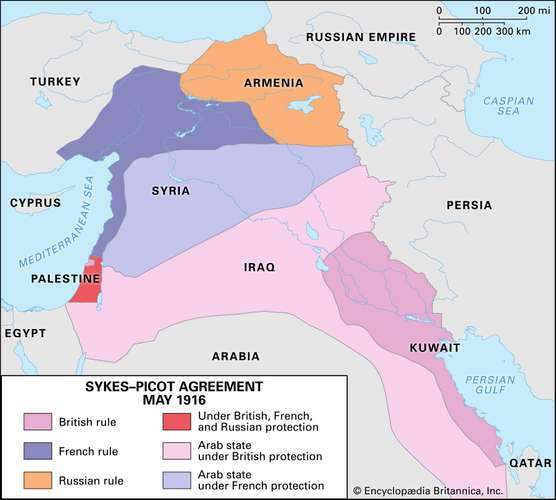
Let’s start with Sykes Picot 1916:


When the British/French/Imperial Russians drew the map of the Middle East during WWI, they didn’t take into account that, specifically in Iraq, there were Shias, Sunnis, and Kurds who may or may not want to be in one state together.

The British propped up a Sunni (Hashemite) King named Feisal I, despite protests by other groups (Shia, Yazidi, Assyrian Christians).
What was the point of having a group with fewer people (Sunni) rule over Iraq rather than Shia (majority)? This gave the Sunni more reason to keep power. They knew if the Shia ever took power, they, as a minority, would have none.

There were many wars, civil wars, coups, etc during the time period after WWI during the British Mandate, then when Iraq became a state (1932), to when it became a Republic (1958) to its time ruled by the Baathists (1963-2002). The Baathists were loyal to the Soviet Union.

Which brings us back to Maj. Gen. Qassim Suleimani.

In 1979, Iran had a revolution to overthrow their monarch Shah Mohamed Reza Pahlavi. Although it wasn’t the intention of all (most?) of the revolutionaries to live under a theocracy, the people who gained control were the Ayatollahs. The Iranians were against the United States because of their support for the Shah and a 1953 CIA sponsored/supported coup against the sitting prime minister of Iran. This hatred culminated in the storming of the US Embassy, where 52 US diplomats were held hostage for 444 days. This is where and when Suleimani got his start.

From 1980 to 1990, Iran and Iraq fought a war that resulted in the deaths of a million people! Suleimani was very involved and considered heroic during this war. Towards the middle of the war, Iraq (which was more loyal to the Soviet Union) was provided arms by the US government.

However, that relationship changed in August 1990, when Saddam Hussein, the leader of Iraq, invaded Kuwait. In the first post-Cold War showdown, in January 1991, the United States, led by George HW Bush, joined or supported by most other Western countries, bombed Iraq forcing Saddam Hussein to withdraw from Kuwait.

Over the next 13 years, the US would accuse Iraq of trying to build or having weapons of mass destruction (WMDs). Two years after the attacks of 9-11, US President George W. Bush convinced Congress that Iraq was an imminent threat leading to the invasion of Iraq in 2003. No WMDs were found, but Saddam Hussein was hanged by Shiite leaders. Since 2003, Iraq has tried to build a democracy, but sectarian tensions have made it difficult as Shiite leaders are in control and former Baath party members (pretty much all adult male Sunnis prior to 2003) were banned from being in government. Given the size of the bureaucracy under Saddam Hussein, this put a lot of people out of work opening an opportunity for militant groups, like ISIS to recruit. When ISIS took Mosul, Iran (and the US) were the ones who "freed it."

Fast forward eight years later, as the Iraqi democracy is struggling, the Arab world revolts against its dictatorships. The short lived Arab spring has had long lasting implications in Syria, kicking off a brutal, ongoing civil war. The Syrian dictator, Bashara al Assad is supported by Iran (re: Maj. Gen. Qassim Suleimani) and Russia in his fight against Sunni rebels, ISIS, and the Kurds. (The US was fighting ISIS by air, while the Iranians were fighting them on the ground, according to the New York Times). His fingers are also in the Yemen Civil War as well as training Hezbollah fighters against Israel. All in an effort to make Iran the supreme Middle East country over Turkey and Saudi Arabia.

Which brings us to why Maj. Gen. Qassim Suleimani was at the Baghdad airport on the last day of his life. Maj. Gen. Qassim Suleimani was also responsible for training Shiite militia who were thwarting democracy in their own country. While the US has a troop presence there, it has essentially left Iraq, meanwhile Iran is there to pick up the pieces. Iran is being held responsible by the US for the murder of a US contractor on December 28 on an Iraqi military base. The US responded by attacking Iranian backed targets in Iraq and Syria. This angered Iraqis, as they said the US was violating their sovereignty. However, the US did not back down, and when Suleimani was at the airport in Baghdad, on his way back from a trip to Syria, he was with with two Popular Mobilization Committee  (Shiite militia) senior officials. The US military provided intelligence to President Trump who ordered the strike which killed all three.  President Trump's predecessors had never ordered a strike on Suleimani so as to not provoke a war with Iran.

You may be wondering how is this legal. Assassinations are not legal, but according to the President and other experts this killing is not an assassination. It is justified force in a military conflict. Other experts say that it does not meet the standard as the US is not at war with Iran.

Iran has vowed revenge and President Trump has vowed to crush Iran if there is any retaliation. The Iraqi parliament has voted to expel US troops. News has broken today that alleges that the Pentagon didn’t actually want President Trump to choose the kill option. Also, Iran has completely backed out of the nuclear treaty it signed under the Obama administration, and in the fallout from this strike the US has already ordered thousands more troops to the Middle East and halt its counter-ISIS efforts.

So, what’s next?

Works Cited

Abdo, Geneive. “Egypt: The Religious Root of Conflicts in the Middle East.” Pulitzer Center, Pulitzer Center on Crisis Reporting, 8 May 2017, pulitzercenter.org/reporting/egypt-religious-root-conflicts-middle-east.

Abdul-Zahra, Qassim. “Syria and Iraq Airstrikes Target Group Blamed for American's Death.” Time, TIME USA, 30 Dec. 2019, time.com/5756651/us-airstrikes-iraq-syria-contractor/.

Anderson, Scott. “Fractured Lands: How the Arab World Came Apart.” The New York Times, The New York Times, 11 Aug. 2016, www.nytimes.com/interactive/2016/08/11/magazine/isis-middle-east-arab-spring-fractured-lands.html.

Arango, Tim, et al. “Qassim Suleimani, Master of Iran's Intrigue, Built a Shiite Axis of Power in Mideast.” The New York Times, The New York Times, 3 Jan. 2020, www.nytimes.com/2020/01/03/obituaries/qassem-soleimani-dead.html.

Berger, Miriam. “Where U.S. Troops Are in the Middle East and Afghanistan, Visualized.” The Washington Post, WP Company, 4 Jan. 2020, www.washingtonpost.com/world/where-us-troops-are-in-the-middle-east-and-could-now-be-a-target-visualized/2020/01/04/1a6233ee-2f3c-11ea-9b60-817cc18cf173_story.html?arc404=true.

Cooper, Helene, et al. “As Tensions With Iran Escalated, Trump Opted for Most Extreme Measure.” The New York Times, The New York Times, 5 Jan. 2020, www.nytimes.com/2020/01/04/us/politics/trump-suleimani.html?action=click&module=Top%2BStories&pgtype=Homepage.

The Editors of Encyclopaedia Britannica. “Sykes-Picot Agreement.” Encyclopædia Britannica, Encyclopædia Britannica, Inc., 13 Nov. 2018, www.britannica.com/event/Sykes-Picot-Agreement.

Hubbard, Ben, et al. “Iran Pulls Back From Nuclear Deal as Killing of Iranian General Upends Mideast.” The New York Times, The New York Times, 5 Jan. 2020, www.nytimes.com/2020/01/05/world/middleeast/iran-general-soleimani-iraq.html?action=click&module=Top%2BStories&pgtype=Homepage.

Kennedy, Merrit, and Jackie Northam. “Was It Legal For The U.S. To Kill A Top Iranian Military Leader?” NPR, NPR, 4 Jan. 2020, www.npr.org/2020/01/04/793412105/was-it-legal-for-the-u-s-to-kill-a-top-iranian-military-leader.

Novak, Jake. “Op-Ed: America Just Took out a Man Many Consider the World's No. 1 Bad Guy.” CNBC, NBC Universal, 3 Jan. 2020, www.cnbc.com/2020/01/02/trump-just-took-out-the-worlds-biggest-bad-guy-qassim-soleimani.html.

“The Sunni-Shia Divide.” Council on Foreign Relations, Council on Foreign Relations, 16 Feb. 2016, www.cfr.org/interactives/sunni-shia-divide#!/sunni-shia-divide.

Tuesday, December 10, 2019

I'm not Oprah, but Here are my Favorite Things

Another day home with my master cougher so I thought I'd write an unusual blog post for me. These are items that I've purchased over the past couple of years that I really love as a mom of young kids. What would have made them even better is if I hadn't had to pay for them!

So I'm providing you with a list of these items. There is a caveat. Besides the books, the kids might not squeal with pleasure over these things. So if you need that affirmation, my list isn't for you. However, their parents will (might) be happy.

Books

1. The Gingerbread Girl
by Lisa Campbell Ernst
Run to get this book appropriate for preschool and up. It's our all time favorite.

2. The Piggy and Gerald Series
by Mo Willems
I dare you not to love these books. I double dare you. These books are good for preschoolers through first grade. 

3. Running Across America: A True Story of Dreams, Determination, and Heading for Home
McGillivray, Dave
The title says it all. Primary grades.

4. Just Ask!: Be Different, Be Brave, Be You
by Sonia Sotomayor
Also for primary grades. I read this to a class of first graders and they loved it. The book details people living with different challenges and describes them in a way appropriate for children. The kids loved it.

5. I Dissent
by Ruth Bader Ginsburg
We bought this for my daughter when she was in Kindergarten, but had I read it in advance I would have waited another year. The book is so awesome and inspiring.


Products

6. Natural Citronella Bracelets (not a specific brand)
This might be a weird gift for the holidays. However, my kids and I are mosquito magnets and use these all of the time during the summer and fall.

7. Trueocity Kids Toothbrush 4 Pack - Soft Contoured Bristles - Child Sized Brush Heads (3-10 year old) -
Yeah, if you get a kid toothbrushes for the holidays, they will probably hate you. However, their dentist will be happy.

8. Stainless Steel Lunch Box and Food Container set
and
LunchBots Medium Uno Stainless Steel Sandwich Container 
These items are a game changer for lunch and snacktime storage. They are also great to use as tupperware. 

9. CamelBak Eddy Kids BPA Free Water Bottle
Although it's annoying to have a water bottle that has parts to it, these hold up well in the dishwasher. Throw in some extra valves and straws. Good for ages 3 to 7. 

10. Mabel's Labels 
Another game changer item. Buy stickers or a stamp with your kid's name on them. No more lost items. No more sewing in name tags. 

11. Ezy Dose Kids True Easy Syringe 2 TSP (10 ml) | Baby and Kids Liquid Medicine Dispenser | Infant Oral Syringe
Okay, I get it. This would be a really strange gift. However, little kids get sick. Some more than others. This product provides assurance that you are giving the correct amount of medicine

12. Physio Logic Fever-Bugz Stick-On Fever Indicator
Another weird one. But no kid likes their temperature taken. You just stick this puppy on their back, lift up their shirts, and you can see if they have a fever. I don't find the number to be all that accurate, but it helps me to determine whether or not to give my child a fever reducer. 

13. Munchkin Arm & Hammer Disposable Changing Pad - 30 Pack
When our kids were babies, we traveled on very long flights. These are very light weight and disposable, so it made our travel easier and a tad bit cleaner.

14. Paint with Water Books
This isn't a specific brand recommendation, but a type of coloring book that only requires the child to use water. It will keep them occupied for at least three minutes.

15. Sight Words Flash Cards
You need to know your "sight words" says every teacher ever. This is a great way to help out a little one to learn them. 

16. Dry Erase Workbooks
Remember when we were kids and you'd write in a workbook and then throw it away? Now there's dry-erase workbooks for kids to learn how to write letters, numbers, and more. You'll need to also buy dry-erase pens because there's no way that one pen is going to last more than a week. 

17. Crayola Washable Kids Paint, 10 Neon Paint Colors, 2oz Bottles, Gift
I'm not sure why these paints are better than any others, but I can tell you my kids love them. 

18. Microsocope for Kids or a Telescope for Kids
Schools are emphasizing science like crazy (STEM/STEAM). In addition, prior to school crushing their souls (not my school) kids still have a natural curiosity for life. These products enhance that curiosity. 

19. Sewing and Knitting Kits for Kids
Look what's back in vogue. Learning to sew and knit is all of the rage now, particularly since kids have such poor fine motor skills. Let them tack a crack at it. It might become a useful skill or a way to wind down from this crazy world. 

20. Disposable Children Placemats Stick-on Table
Admittedly, not great for the environment, but these are lifesavers if you are traveling and need to feed your kid in places that just aren't that clean. 

I hope this list was helpful. The cougher is napping, but I need to wake him up. Have a happy holiday season. 

Friday, December 6, 2019

What's really behind the Dolores-Jackie conflict on the RHONJ

I watch five shows on Bravo. One of them is The Real Housewives of New Jersey. I mostly watch as a form of escapism, and as a way to turn off my brain and focus on something totally superficial. However, sometimes I find the character arcs provide fascinating studies in human behavior, sociology, and psychology.

The last two episodes of the RHONJ delivered on all fronts, and I'm wondering if the editors crafted the storyline purposefully.


If somehow you don't know, the docudrama films several women from New Jersey who are wealthy. The women get paid fairly well to get into conflicts and attract Twitter followers. The motivation also is to have 20-something minutes a week for 21 weeks to promote whatever product the person is pushing at the time. Examples include a clothing store, cookbooks, a husband's plastic surgery practice, etc. Sometimes there's a charitable aspect to the promotion when the woman champions a philanthropy and the event is center stage for some ratings friendly drama. 


                            'Real Housewives of New Jersey': Dolores may find Jackie to be hypersensitive, but fans are rooting for her
The conflict that is intriguing me is the one between Dolores Catania and Jackie GoldSchneider. At a dinner during a trip to Jamaica, it is revealed and confirmed that Dolores does not like Jackie. It's a rather rude admission based on the fact that Jackie is not Dolores's "cup of tea." Nor is she "cut from the same cloth" as Dolores and her friend Teresa Giudice.

However, when you examine the conflict closer, it is not over culture or the way each were raised. Instead it is over something they have in common: an eating disorder or at the very least an over-preoccupation with weight. Jackie, as we were told last season is a recovering Anorexic. You can practically hear the director telling the cameraman to focus in on her barely eaten plate. Jackie, the child of Jewish liberal professionals, is a writer (the show has helped her writing career), smart and sensitive. 

Dolores is tough as nails. She lives with her ex-husband and father of her children. Together they rehab houses, run a gym and have a frequent-customer card at a nearby a spray tan place.

While it's understandable that these two might not have a lot in common, what's causing conflict is their shared eating disorder. Dolores calls her ex-husband Frank to complain about being fat. She talks about being fat on the beach. She wears a cover up while her friends flaunt their bodies. She looks physically uncomfortable trying to hide whatever imperfection she perceives.

Indeed, while Jackie has addressed her issue through a dietician and therapy and admits to having a problem, Dolores languishes in self hatred. (By the way, Dolores looks great. She's very fit). However, often the parts of ourselves that we don't like are the parts in others that we find the most irritating and unbearable. Dolores hates Jackie's vulnerability, sensitivity, honesty, openness and intelligence. These very qualities Dolores wishes she could access, but can't. So what does she do? She is mean and acts like a classic bully, even imitating Jackie's voice like my preschool-aged son does. 

I hope as the season goes on, Dolores addresses her own food and body demons and apologizes to Jackie. I hope Dolores learns to love herself. 

I hope you haven't judged me too much for writing this. :) 


Thursday, November 28, 2019

Wanted: Holocaust Cybereducators

Please read my post that was published in eJewish Philanthropy a few months back. 

https://ejewishphilanthropy.com/wanted-holocaust-cybereducators/