Maj. Gen. Qassim Suleimani, head of the Quds Force was killed by a US drone at the Baghdad airport on January 3, 2020.
The Quds Force is kind of more like the CIA. It was created, in part, with the mandate of liberating Muslim lands, especially Jerusalem (called al-Quds in Arabic. It’s a cognate with the word “kadosh” in Hebrew).
Why?
Qasem Soleimani has been in control of Iran’s Quds Force for more than 20 years. His current greatest hits include helping Bashar al Assad slaughter hundreds of thousands of his own people in the Syrian civil war, stoking the Houthis in Yemen’s civil war, and overseeing the killing of hundreds of Iraqi protesters recently demonstrating against Iranian influence in their country. But most importantly for Americans, Soleimani was behind the deaths of hundreds of American soldiers during the Iraq War. Last year, the U.S. State Department put the number of Americans killed by Iranian proxies in Iraq at 608 since 2003...The killing of hundreds of our troops in Iraq, the constant terrorism it sponsors and supplies against Israel, and even the recent provocations against oil traffic in the Persian Gulf are all acts of war from which there really is no retreat without severe consequences (Novak).
Beginning with why was an Iranian Major General, an avid enemy of the United States, hanging out at the Baghdad airport, a country that continues to have a pretty decent sized US military presence (approximated at 6000).

Let’s start with Sykes Picot 1916:
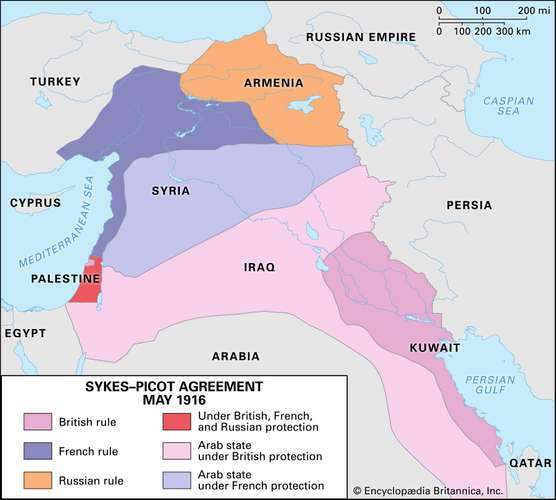
When the British/French/Imperial Russians drew the map of the Middle East during WWI, they didn’t take into account that, specifically in Iraq, there were Shias, Sunnis, and Kurds who may or may not want to be in one state together.
The British propped up a Sunni (Hashemite) King named Feisal I, despite protests by other groups (Shia, Yazidi, Assyrian Christians).
What was the point of having a group with fewer people (Sunni) rule over Iraq rather than Shia (majority)? This gave the Sunni more reason to keep power. They knew if the Shia ever took power, they, as a minority, would have none.
There were many wars, civil wars, coups, etc during the time period after WWI during the British Mandate, then when Iraq became a state (1932), to when it became a Republic (1958) to its time ruled by the Baathists (1963-2002). The Baathists were loyal to the Soviet Union.
Which brings us back to Maj. Gen. Qassim Suleimani.
In 1979, Iran had a revolution to overthrow their monarch Shah Mohamed Reza Pahlavi. Although it wasn’t the intention of all (most?) of the revolutionaries to live under a theocracy, the people who gained control were the Ayatollahs. The Iranians were against the United States because of their support for the Shah and a 1953 CIA sponsored/supported coup against the sitting prime minister of Iran. This hatred culminated in the storming of the US Embassy, where 52 US diplomats were held hostage for 444 days. This is where and when Suleimani got his start.
From 1980 to 1990, Iran and Iraq fought a war that resulted in the deaths of a million people! Suleimani was very involved and considered heroic during this war. Towards the middle of the war, Iraq (which was more loyal to the Soviet Union) was provided arms by the US government.
However, that relationship changed in August 1990, when Saddam Hussein, the leader of Iraq, invaded Kuwait. In the first post-Cold War showdown, in January 1991, the United States, led by George HW Bush, joined or supported by most other Western countries, bombed Iraq forcing Saddam Hussein to withdraw from Kuwait.
Over the next 13 years, the US would accuse Iraq of trying to build or having weapons of mass destruction (WMDs). Two years after the attacks of 9-11, US President George W. Bush convinced Congress that Iraq was an imminent threat leading to the invasion of Iraq in 2003. No WMDs were found, but Saddam Hussein was hanged by Shiite leaders. Since 2003, Iraq has tried to build a democracy, but sectarian tensions have made it difficult as Shiite leaders are in control and former Baath party members (pretty much all adult male Sunnis prior to 2003) were banned from being in government. Given the size of the bureaucracy under Saddam Hussein, this put a lot of people out of work opening an opportunity for militant groups, like ISIS to recruit. When ISIS took Mosul, Iran (and the US) were the ones who "freed it."
Fast forward eight years later, as the Iraqi democracy is struggling, the Arab world revolts against its dictatorships. The short lived Arab spring has had long lasting implications in Syria, kicking off a brutal, ongoing civil war. The Syrian dictator, Bashara al Assad is supported by Iran (re: Maj. Gen. Qassim Suleimani) and Russia in his fight against Sunni rebels, ISIS, and the Kurds. (The US was fighting ISIS by air, while the Iranians were fighting them on the ground, according to the New York Times). His fingers are also in the Yemen Civil War as well as training Hezbollah fighters against Israel. All in an effort to make Iran the supreme Middle East country over Turkey and Saudi Arabia.
Which brings us to why Maj. Gen. Qassim Suleimani was at the Baghdad airport on the last day of his life. Maj. Gen. Qassim Suleimani was also responsible for training Shiite militia who were thwarting democracy in their own country. While the US has a troop presence there, it has essentially left Iraq, meanwhile Iran is there to pick up the pieces. Iran is being held responsible by the US for the murder of a US contractor on December 28 on an Iraqi military base. The US responded by attacking Iranian backed targets in Iraq and Syria. This angered Iraqis, as they said the US was violating their sovereignty. However, the US did not back down, and when Suleimani was at the airport in Baghdad, on his way back from a trip to Syria, he was with with two Popular Mobilization Committee (Shiite militia) senior officials. The US military provided intelligence to President Trump who ordered the strike which killed all three. President Trump's predecessors had never ordered a strike on Suleimani so as to not provoke a war with Iran.
You may be wondering how is this legal. Assassinations are not legal, but according to the President and other experts this killing is not an assassination. It is justified force in a military conflict. Other experts say that it does not meet the standard as the US is not at war with Iran.
Iran has vowed revenge and President Trump has vowed to crush Iran if there is any retaliation. The Iraqi parliament has voted to expel US troops. News has broken today that alleges that the Pentagon didn’t actually want President Trump to choose the kill option. Also, Iran has completely backed out of the nuclear treaty it signed under the Obama administration, and in the fallout from this strike the US has already ordered thousands more troops to the Middle East and halt its counter-ISIS efforts.
So, what’s next?
Works Cited
Abdo, Geneive. “Egypt: The Religious Root of Conflicts in the Middle East.” Pulitzer Center, Pulitzer Center on Crisis Reporting, 8 May 2017, pulitzercenter.org/reporting/egypt-religious-root-conflicts-middle-east.
Abdul-Zahra, Qassim. “Syria and Iraq Airstrikes Target Group Blamed for American's Death.” Time, TIME USA, 30 Dec. 2019, time.com/5756651/us-airstrikes-iraq-syria-contractor/.
Anderson, Scott. “Fractured Lands: How the Arab World Came Apart.” The New York Times, The New York Times, 11 Aug. 2016, www.nytimes.com/interactive/2016/08/11/magazine/isis-middle-east-arab-spring-fractured-lands.html.
Arango, Tim, et al. “Qassim Suleimani, Master of Iran's Intrigue, Built a Shiite Axis of Power in Mideast.” The New York Times, The New York Times, 3 Jan. 2020, www.nytimes.com/2020/01/03/obituaries/qassem-soleimani-dead.html.
Berger, Miriam. “Where U.S. Troops Are in the Middle East and Afghanistan, Visualized.” The Washington Post, WP Company, 4 Jan. 2020, www.washingtonpost.com/world/where-us-troops-are-in-the-middle-east-and-could-now-be-a-target-visualized/2020/01/04/1a6233ee-2f3c-11ea-9b60-817cc18cf173_story.html?arc404=true.
Cooper, Helene, et al. “As Tensions With Iran Escalated, Trump Opted for Most Extreme Measure.” The New York Times, The New York Times, 5 Jan. 2020, www.nytimes.com/2020/01/04/us/politics/trump-suleimani.html?action=click&module=Top%2BStories&pgtype=Homepage.
The Editors of Encyclopaedia Britannica. “Sykes-Picot Agreement.” Encyclopædia Britannica, Encyclopædia Britannica, Inc., 13 Nov. 2018, www.britannica.com/event/Sykes-Picot-Agreement.
Hubbard, Ben, et al. “Iran Pulls Back From Nuclear Deal as Killing of Iranian General Upends Mideast.” The New York Times, The New York Times, 5 Jan. 2020, www.nytimes.com/2020/01/05/world/middleeast/iran-general-soleimani-iraq.html?action=click&module=Top%2BStories&pgtype=Homepage.
Kennedy, Merrit, and Jackie Northam. “Was It Legal For The U.S. To Kill A Top Iranian Military Leader?” NPR, NPR, 4 Jan. 2020, www.npr.org/2020/01/04/793412105/was-it-legal-for-the-u-s-to-kill-a-top-iranian-military-leader.
Novak, Jake. “Op-Ed: America Just Took out a Man Many Consider the World's No. 1 Bad Guy.” CNBC, NBC Universal, 3 Jan. 2020, www.cnbc.com/2020/01/02/trump-just-took-out-the-worlds-biggest-bad-guy-qassim-soleimani.html.
“The Sunni-Shia Divide.” Council on Foreign Relations, Council on Foreign Relations, 16 Feb. 2016, www.cfr.org/interactives/sunni-shia-divide#!/sunni-shia-divide.
There were many wars, civil wars, coups, etc during the time period after WWI during the British Mandate, then when Iraq became a state (1932), to when it became a Republic (1958) to its time ruled by the Baathists (1963-2002). The Baathists were loyal to the Soviet Union.
Which brings us back to Maj. Gen. Qassim Suleimani.
In 1979, Iran had a revolution to overthrow their monarch Shah Mohamed Reza Pahlavi. Although it wasn’t the intention of all (most?) of the revolutionaries to live under a theocracy, the people who gained control were the Ayatollahs. The Iranians were against the United States because of their support for the Shah and a 1953 CIA sponsored/supported coup against the sitting prime minister of Iran. This hatred culminated in the storming of the US Embassy, where 52 US diplomats were held hostage for 444 days. This is where and when Suleimani got his start.
From 1980 to 1990, Iran and Iraq fought a war that resulted in the deaths of a million people! Suleimani was very involved and considered heroic during this war. Towards the middle of the war, Iraq (which was more loyal to the Soviet Union) was provided arms by the US government.
However, that relationship changed in August 1990, when Saddam Hussein, the leader of Iraq, invaded Kuwait. In the first post-Cold War showdown, in January 1991, the United States, led by George HW Bush, joined or supported by most other Western countries, bombed Iraq forcing Saddam Hussein to withdraw from Kuwait.
Over the next 13 years, the US would accuse Iraq of trying to build or having weapons of mass destruction (WMDs). Two years after the attacks of 9-11, US President George W. Bush convinced Congress that Iraq was an imminent threat leading to the invasion of Iraq in 2003. No WMDs were found, but Saddam Hussein was hanged by Shiite leaders. Since 2003, Iraq has tried to build a democracy, but sectarian tensions have made it difficult as Shiite leaders are in control and former Baath party members (pretty much all adult male Sunnis prior to 2003) were banned from being in government. Given the size of the bureaucracy under Saddam Hussein, this put a lot of people out of work opening an opportunity for militant groups, like ISIS to recruit. When ISIS took Mosul, Iran (and the US) were the ones who "freed it."
Fast forward eight years later, as the Iraqi democracy is struggling, the Arab world revolts against its dictatorships. The short lived Arab spring has had long lasting implications in Syria, kicking off a brutal, ongoing civil war. The Syrian dictator, Bashara al Assad is supported by Iran (re: Maj. Gen. Qassim Suleimani) and Russia in his fight against Sunni rebels, ISIS, and the Kurds. (The US was fighting ISIS by air, while the Iranians were fighting them on the ground, according to the New York Times). His fingers are also in the Yemen Civil War as well as training Hezbollah fighters against Israel. All in an effort to make Iran the supreme Middle East country over Turkey and Saudi Arabia.
Which brings us to why Maj. Gen. Qassim Suleimani was at the Baghdad airport on the last day of his life. Maj. Gen. Qassim Suleimani was also responsible for training Shiite militia who were thwarting democracy in their own country. While the US has a troop presence there, it has essentially left Iraq, meanwhile Iran is there to pick up the pieces. Iran is being held responsible by the US for the murder of a US contractor on December 28 on an Iraqi military base. The US responded by attacking Iranian backed targets in Iraq and Syria. This angered Iraqis, as they said the US was violating their sovereignty. However, the US did not back down, and when Suleimani was at the airport in Baghdad, on his way back from a trip to Syria, he was with with two Popular Mobilization Committee (Shiite militia) senior officials. The US military provided intelligence to President Trump who ordered the strike which killed all three. President Trump's predecessors had never ordered a strike on Suleimani so as to not provoke a war with Iran.
You may be wondering how is this legal. Assassinations are not legal, but according to the President and other experts this killing is not an assassination. It is justified force in a military conflict. Other experts say that it does not meet the standard as the US is not at war with Iran.
Iran has vowed revenge and President Trump has vowed to crush Iran if there is any retaliation. The Iraqi parliament has voted to expel US troops. News has broken today that alleges that the Pentagon didn’t actually want President Trump to choose the kill option. Also, Iran has completely backed out of the nuclear treaty it signed under the Obama administration, and in the fallout from this strike the US has already ordered thousands more troops to the Middle East and halt its counter-ISIS efforts.
So, what’s next?
Works Cited
Abdo, Geneive. “Egypt: The Religious Root of Conflicts in the Middle East.” Pulitzer Center, Pulitzer Center on Crisis Reporting, 8 May 2017, pulitzercenter.org/reporting/egypt-religious-root-conflicts-middle-east.
Abdul-Zahra, Qassim. “Syria and Iraq Airstrikes Target Group Blamed for American's Death.” Time, TIME USA, 30 Dec. 2019, time.com/5756651/us-airstrikes-iraq-syria-contractor/.
Anderson, Scott. “Fractured Lands: How the Arab World Came Apart.” The New York Times, The New York Times, 11 Aug. 2016, www.nytimes.com/interactive/2016/08/11/magazine/isis-middle-east-arab-spring-fractured-lands.html.
Arango, Tim, et al. “Qassim Suleimani, Master of Iran's Intrigue, Built a Shiite Axis of Power in Mideast.” The New York Times, The New York Times, 3 Jan. 2020, www.nytimes.com/2020/01/03/obituaries/qassem-soleimani-dead.html.
Berger, Miriam. “Where U.S. Troops Are in the Middle East and Afghanistan, Visualized.” The Washington Post, WP Company, 4 Jan. 2020, www.washingtonpost.com/world/where-us-troops-are-in-the-middle-east-and-could-now-be-a-target-visualized/2020/01/04/1a6233ee-2f3c-11ea-9b60-817cc18cf173_story.html?arc404=true.
Cooper, Helene, et al. “As Tensions With Iran Escalated, Trump Opted for Most Extreme Measure.” The New York Times, The New York Times, 5 Jan. 2020, www.nytimes.com/2020/01/04/us/politics/trump-suleimani.html?action=click&module=Top%2BStories&pgtype=Homepage.
The Editors of Encyclopaedia Britannica. “Sykes-Picot Agreement.” Encyclopædia Britannica, Encyclopædia Britannica, Inc., 13 Nov. 2018, www.britannica.com/event/Sykes-Picot-Agreement.
Hubbard, Ben, et al. “Iran Pulls Back From Nuclear Deal as Killing of Iranian General Upends Mideast.” The New York Times, The New York Times, 5 Jan. 2020, www.nytimes.com/2020/01/05/world/middleeast/iran-general-soleimani-iraq.html?action=click&module=Top%2BStories&pgtype=Homepage.
Kennedy, Merrit, and Jackie Northam. “Was It Legal For The U.S. To Kill A Top Iranian Military Leader?” NPR, NPR, 4 Jan. 2020, www.npr.org/2020/01/04/793412105/was-it-legal-for-the-u-s-to-kill-a-top-iranian-military-leader.
Novak, Jake. “Op-Ed: America Just Took out a Man Many Consider the World's No. 1 Bad Guy.” CNBC, NBC Universal, 3 Jan. 2020, www.cnbc.com/2020/01/02/trump-just-took-out-the-worlds-biggest-bad-guy-qassim-soleimani.html.
“The Sunni-Shia Divide.” Council on Foreign Relations, Council on Foreign Relations, 16 Feb. 2016, www.cfr.org/interactives/sunni-shia-divide#!/sunni-shia-divide.

